PhD Funding Programmes Should Offer Four Year Studentships PhD's are officially three years programmes in the UK, but it is now very common for students to take four years to finish their thesis. Most PhD students won't become lecturers but most want it to happen and the increased demands of the academic job market require that you give papers, organise conferences, write publications, and teach during your PhD. Doing all of these things will not guarantee you a job or make you stand out from the competition, it just means that you are meeting the bare minimum expected of you when you go on to apply for postdocs and early lecturing jobs. Like many others, I've done all of the above during my PhD, and it's undeniable that it has knocked a year out of my research time. I've spoken to lecturers and they've told me that my publication was "done correctly" if it took that much time out of my research. I will be taking a fourth year to finish up m...
Posts
Why Classics Isn’t For Everyone Classics is for everyone! It’s a phrase often used to defend the subject, and in fairness, it comes from a kindhearted place. People use it because they understand that there are obvious structural barriers if you want to make it into Classics, including but not limited to, class, education, gender, race and sexuality. Their response is that Classics is often presented in the public mind as an elitist subject, but in reality, it has appeal for everyone. I do agree that Classics is a subject which everyone can love, but I also believe that the expression ‘Classics is for everyone’ is also not really true because of how the subject currently exists in the education sector. And before I go any further, I’m talking specifically about the UK here. I’m aware that the situation is apparently better in countries such as Italy, just as one example. Unfortunately, I’m a typical dumb English man, so you’ll have to forgive my ignorance when it comes to the...
Universities are not Marxist The conspiracy theory that universities are hard-left institutions which indoctrinate their students into becoming hardened Marxists is prevalent in certain right-wing spheres. There are some embarrassing posts recently being made by TurningPointUK about lecturers trying to brainwash their students on campus and marking them down if they refuse to adopt their views. It reminded me about this long-standing theory, so here I am to demolish it. Let’s try to see if this theory has any merit and play fairly. It is true that most universities (at least in the UK, which is what I know most about personally) put on a show of being invested in diversity issues, such as LGBT rights, feminism, race and supporting more representation of traditionally excluded groups. Whether this is just rhetoric or something they actually deliver on is a matter of debate. It is also true that most lecturers I know are strongly in favour of remain and were against Brexit. N...
Imposter Syndrome and Classics Imposter syndrome is a popular topic in academic and student circles but it's also a term which has been criticised. To some, it deflects away class and institutional rooted anxities as a feeling which is in someone's head. I have suffered from imposter syndrome for nearly ten years, so I thought it would be interesting to provide my own perspective. I think it's crucial to note that the most common reason for imposter syndrome in Classics is a feeling of incompetence in classical languages. I think the key problem here is the different cultural approaches which state comprehensive school students and grammar and private students have to Classics. The comprehensive sector typically teaches Classical Civilisation, where the texts are studied in translation and the grammar and private sector teaches Classics, where language ability is the focus. Both are valuable disciplines, but it's no secret that academia has a huge preference for Cla...
Why I Am Not Pursuing Academia This has been a long time coming. I decided last year that academia wasn’t the right career path for me, but there’s always been a thought in the back of my head which has urged me to push on with it. In my two years of being a visiting lecturer, there’s many aspects of the job I’ve enjoyed. I feel very lucky to have taught at the University of Roehampton, as I’ve been supported by my department, supervisors and have been paid generously compared to other PhD students I know at other universities. I absolutely adore teaching and have been blessed with excellent students who were always engaged. In fact, teaching Classics at secondary schools is a career path I’m still considering and would be delighted to get into. I’ve also had many opportunities which I’m fully aware other PhD students would envy. I’ve taught many sessions for two years, including several lectures and I know other universities don’t offer these easily. I’ve given many ...
Why Classical Civilisation is Great I have studied both Classical Civilisation (for A Level and BA) and Classics (for MA and PhD) and love both subjects a great deal. However, my education in Classical Civilisation has arguably been the most significant in my life and continues to guide me in my pursuit of Classics. It’s a fact that many are uncomfortable to talk about, but there are some in Classics who hold Classical Civilisation in disdain. Unfortunately, some of them have been Classics and even Classical Civilisation students. Here’s just one particularly crazy story: I was once told by a lecturer (and I’m quoting here) “do you actually study Classics? Oh, Classical Civilisation… Hmm, isn’t that when you learn what the Romans used to eat?” That remark was particularly funny in hindsight, because it was intended as an insult, but I would years later discuss with Andrew Wallace-Hadrill, on...
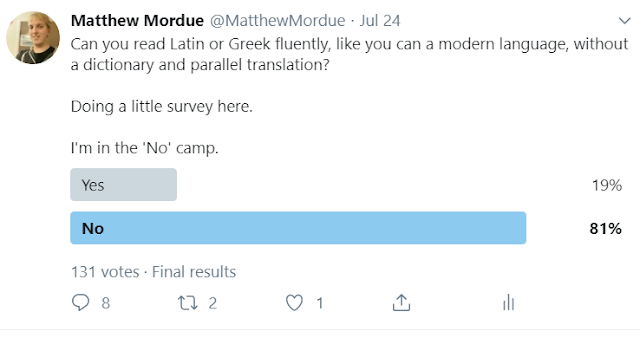
Classics Students and Latin Proficiency I started learning Latin at 19, and while I’ve read hundreds of lines and devoted many years to improving my skills, I still don’t consider myself fluent. For many years, this was something which always bugged me, and I thought maybe I was incompetent or just really bad at learning languages. However, I’ve learnt over the years that many other Classics students have the same struggles which I faced in my studies, it’s just not something I commonly see expressed or talked about. To be fair, my evidence has been anecdotal: I heard such stories when talking to close friends or those who I’ve met at conferences. Consequently, it was something I always thought a lot about, but since I don’t believe there’s much or any research on the topic, I would never actually talk seriously about. However, one day I decided to run a poll on Twitter to try and get some more concrete evidence. The statistics are of course not completely reliable, becau...